An update from my previous post about the digital divide:
First, I should disclose that I am now blogging from a laptop made in the CURRENT CALENDAR YEAR with the Windows 8 and everything. I can't tell you what a difference it makes to be able to run two programs simultaneously, to not have a half hour boot-up time, or to be able to open iTunes without crashing the whole works.
This makes me only more adamant in my witness of the digital divide. Yes, technology is awesome -- I totally get that. But it is simply not accessible to everyone. A friend moved about a half an hour outside of town, and though the neighbors one block over have cable TV and Internet, the cable just doesn't cross the street. The good people at Time Warner Cable said they'd be happy to run a cable out to her house for the low-low price of $20,000. She now waits until she drives into town to check her e-mail at the bookstore cafe on her laptop. Now imagine that you can't afford a laptop and so you are one of the millions of Americans who can only access the Internet in half hour increments at the public library. Doesn't it make you want to lobby your elected officials for a "Rural Internet Act" in the spirit of the "Rural Electrification Act" that brought the electric light to rural America in the late 1930s? Perhaps some kind of governmental computer upgrade program so that not only would every home have a computer, but one that us up-to-date enough to run the current version of, let's say, iTunes?
Second, I am disturbed by the fundamental misunderstanding of why the technological divide exists. On the Colbert Report last spring, Google's Eric Schmidt said "In the next few years years 5 Billion people are going to join the 2 billion of us who are already on it." [this is around 3 minutes into the video] He says tht these are the 5 billion people, [like me], who are currently using "dumb phones" in places like "Africa, Asia and the poor parts of America." Apparently we are all going to be converted to smart phones. But Mr. Schmidt does not explain how all of these folks [like me] are going to pay for their data plans. Nor does he explain how we are going to extend cell phone coverage to all those currently un-covered areas [like my friend's house] that are too sparsely populated to seem worth covering by for-profit corporations.
I also recommend that Mr. Schmidt check his math -- there are only a total of 7 billion people in the world today, and though in fact 6 million of us do have a cell phone of some kind, Mr. Schmidt's math is off by a billion people who have no cell phone of any kind. I don't think we can assume they are all going to be part of the internet comunity "in the next few years."
It reminds me of the green revolution back in the 70s. We were going to radically change our agricultural practices so that we could fight hunger around the globe. Recently a World Bank report showed that it is actually not a lack of food that creates global hunger, but a lack of money to pay for said food. According to the United Nations, there are 870 million chronically hungry people in the world today. 2.5 billion people lack access to proper sanitation. If we can't even get food and clean water to all 7 billion people in the world, how on earth do we think we are going to get each and every one of them a smart phone? It feels a little like Marie Antoinette's admonition to "let them eat cake."
Wednesday, July 31, 2013

Monday, July 29, 2013
Festival Fashion- Part 3
But when it comes down to it, Festival Fashion is about finding a way to express the moment.
Here we were under the blazing mid-day sun on the infield listening to Bronwen Exter, when this gorgeous breeze came up. Suddenly the diaphanous skirt captured the zeitgeist of the moment beautifully.
Check out Bronwyn Exter in her flowy asymmetrical dress and cowboy boots
 And her kick-ass fans.
After Fatoumata Diawara's mind-blowing sets on the Infield and the Grandstand, I predict this bustier, mini and pattern leggings will be "must wear" for all Grassroots band leaders.


 After a few hours of carrying all your belongings on your back, you start to covet your neighbor's utility kilt
I have got to find out who made these harem cargo-pants

By Friday morning the fashion-istas are hung over and covered in mud and it is time to let your Grassroots fly. To do that I recommend:
this bag
And obviously a tail

Wings


The royal blue napoleon jacket I saw on a shaved head young man when my camera was back at camp.

And a Parasol


Here we were under the blazing mid-day sun on the infield listening to Bronwen Exter, when this gorgeous breeze came up. Suddenly the diaphanous skirt captured the zeitgeist of the moment beautifully.

Check out Bronwyn Exter in her flowy asymmetrical dress and cowboy boots

After Fatoumata Diawara's mind-blowing sets on the Infield and the Grandstand, I predict this bustier, mini and pattern leggings will be "must wear" for all Grassroots band leaders.


 After a few hours of carrying all your belongings on your back, you start to covet your neighbor's utility kilt
 I have got to find out who made these harem cargo-pants


By Friday morning the fashion-istas are hung over and covered in mud and it is time to let your Grassroots fly. To do that I recommend:
this bag

And obviously a tail

Wings


The royal blue napoleon jacket I saw on a shaved head young man when my camera was back at camp.

And a Parasol
[At one point I started to feel guilty- was I some heartless paparazzi? So I screwed
up my courage and approached some of my subjects directly asking "Can I take your photo for my blog?" This Father Daughter duo was the first. They jumped right in like pros.]
In fact by the end of the weekend it seemed most people just love to vogue.

By Sunday when the happiness parade circles the festival there is only one fashion rule- let your freak flag fly.

Epilogue: The patchwork maxi proved impractical in a series of drenching rains and ensuing mud. I have visions of harem pants and feathers next year. I can't wait.
Festival Fashion - Part 2
"But what am to wear with my lace top and cut-offs?" you are undoubtedly asking yourself.
Let's start at the bottom --Generally folks at GrassRoots are pretty utilitarian about shoes. A good shoe can handle not only heat but rain and mud and many hours of dancing

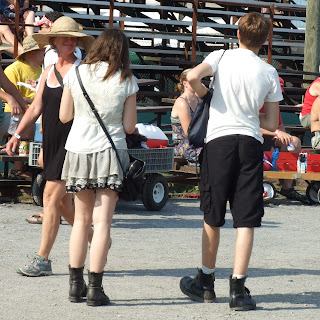

 Here we have the lead singer for Elastic Bond working her boots Miami-style.

 When I asked this woman to pose, she was skeptical of my credentials- apparently she had somehow never heard of the Carrots and Ginger...


Coming up next... Capturing the Zeitgeist
Let's start at the bottom --Generally folks at GrassRoots are pretty utilitarian about shoes. A good shoe can handle not only heat but rain and mud and many hours of dancing
But we do love our boots- even on the hot hot days (but especially on those muddy days and cool evenings).


And my favorite boot vogue...

 When I asked this woman to pose, she was skeptical of my credentials- apparently she had somehow never heard of the Carrots and Ginger...
She so captured the spirit of the moment I had to share another photo with better light.
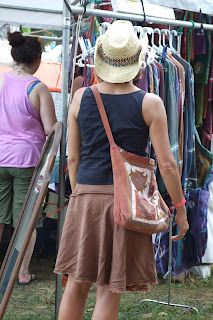
Now to the top -- if you are not wearing flowers in your hair, you may want to consider a hat.


But before you start in with the face and body paint, I recommend changing out of your white lace dress.


Coming up next... Capturing the Zeitgeist
Festival Fashion - Part 1
I had just found this unexpected patchwork maxi skirt in the most unexpected thrift shop. My sister looked at me quizzically until I explained "It's a festival skirt."
In the ensuing conversation she mentioned that many of the fashion blogs are obsessed with festival fashion right now. (There are fashion blogs about festival fashion? There are Fashion blogs?)
In the week leading up to our Grassroots festival she shot me links to several of said blogs, and finally parked in line for Car-camping waiting for the gates of the festival to open, I blithely promised here photos and updates on Grassroots 2013 festival fashion. This is what ensued.
After a heated discussion about under what circumstances a bra is a shirt, and the bravery of women wearing white dresses in the drenching downpour and ensuing mud, I started surreptitiously taking photos to try to capture the GrassRoots 2013 trends:
First- It goes without saying that the very short cut-offs were everywhere. Something creepy about photographing women's rear-ends in their short shorts without permission so I'll leave you to your own devices on that.
Second- the white lace dress/top. Came out of no where this year.


 (Who are these brave girls wearing white dresses in this mud?)
Third - the number of women wearing flowers in their hair went up exponentially this year. Apparently my sister and I were not the only ones that saw the Coachella blogs


I like this fresh take on the festival flower...
Notice that this young woman is rocking the flowers, the cut offs and the white lace. A moment of festival fashion convergence.

Coming up- feet and heads...
In the ensuing conversation she mentioned that many of the fashion blogs are obsessed with festival fashion right now. (There are fashion blogs about festival fashion? There are Fashion blogs?)
In the week leading up to our Grassroots festival she shot me links to several of said blogs, and finally parked in line for Car-camping waiting for the gates of the festival to open, I blithely promised here photos and updates on Grassroots 2013 festival fashion. This is what ensued.
After a heated discussion about under what circumstances a bra is a shirt, and the bravery of women wearing white dresses in the drenching downpour and ensuing mud, I started surreptitiously taking photos to try to capture the GrassRoots 2013 trends:
First- It goes without saying that the very short cut-offs were everywhere. Something creepy about photographing women's rear-ends in their short shorts without permission so I'll leave you to your own devices on that.
Second- the white lace dress/top. Came out of no where this year.


Third - the number of women wearing flowers in their hair went up exponentially this year. Apparently my sister and I were not the only ones that saw the Coachella blogs

I believe this one was made with actual flowers...

I like this fresh take on the festival flower...
Notice that this young woman is rocking the flowers, the cut offs and the white lace. A moment of festival fashion convergence.

Coming up- feet and heads...
Wednesday, July 17, 2013
Not the right question
I was at a conference about social justice and immigration reform-- the Unitarian Universalists have been focused on this "Immigration as a moral issue" for the past couple of years. This day-long conference had some great speakers and I filled page after page in my notebook with all I learned that day. I raised my hand just once to ask about the assertion that immigrant labor is critical to industries like agriculture because "no American worker would want those jobs." Since, in addition to being a minister I work part time as office manager of an organic farm, I thought of all those job inquiries clogging the farm e-mail. When we post an opening (and even when we don't) we get a steady stream of qualified applicants, most of whom are American citizens. I asked the panel "if the agricultural jobs are so miserable that citizens won't apply for them, maybe there is something wrong with the job?" and offered our farm as an alternative example. This was the wrong question apparently- there was an awkward silence and a quick change of subject.
Now I happen to be probably as far to the left as one can get on issues of immigration reform, but I feel there is a deeper issue that needs to be part of the conversation. For centuries American industry has recruit immigrants to fill jobs that are crappy. Not because American citizens are so lazy they won't do a day of hard work, but because it's much harder to exploit workers who know their rights and are rooted in local community. Perhaps American citizens would be more willing to apply for jobs in industrial agriculture if:
There are a lot of important questions we need to ask about immigration policy right now. But let's not forget to ask- if there are jobs that American Citizens won't do, is there something wrong with those jobs? Because safety, fair pay and dignity are the rights of all persons, regardless of their citizenship status.
Now I happen to be probably as far to the left as one can get on issues of immigration reform, but I feel there is a deeper issue that needs to be part of the conversation. For centuries American industry has recruit immigrants to fill jobs that are crappy. Not because American citizens are so lazy they won't do a day of hard work, but because it's much harder to exploit workers who know their rights and are rooted in local community. Perhaps American citizens would be more willing to apply for jobs in industrial agriculture if:
- It were not one of the leading industries for sexual assault! According to the Huffington Post, "In the Central Valley, a 2010 survey of 150 women farmworkers by a researcher from the University of California at Santa Cruz found that 80% had experienced some form of sexual harassment". Wow.
- If agricultural workers were not exempt from many of the same protections provided to every other worker in America-- like collective bargaining, overtime pay, and a day of rest each week.
- If agricultural work was not one of the most hazardous- causing more deaths than construction and mining. And remember, these are mostly jobs with no health care or disability insurance.
- If wage theft was not so common.
- If you could get a drink of water when you were thirsty; it seems that A North Carolina survey found "only 4% of farmworkers surveyed had access to drinking water, hand washing facilities, and toilets."
- If you could enjoy the fruits of your labor. At the farm where I work they grow just about every fruit and vegetable that can be grown in our area, and all the farmworkers (and office staff) are offered "food from themselves and their families." People VOLUNTEER at our farm just to get a taste of strawberries or snow peas fresh picked and organic. (I think this is not so enticing if the farm where you work grows only corn or soy.)
- If there was a chance for learning, advancement and growth. Because truth be told many folks who come work at our farm hope one day to have a farm of their own- or this is what they say in their cover letters anyway. Some folks work at the farm for a season and learn definitively that farming is not for them. Others come back season after season and are given opportunities for advancement. Some people just love to have their hands in the soil.
- If farm workers were treated with fairness, respect and dignity. That's what it all comes down to really. I suspect part of the reason our in-box is filled with hopeful resumes is because workers at our farm are treated with fairness and respect.
There are a lot of important questions we need to ask about immigration policy right now. But let's not forget to ask- if there are jobs that American Citizens won't do, is there something wrong with those jobs? Because safety, fair pay and dignity are the rights of all persons, regardless of their citizenship status.
Monday, September 03, 2012
Friday, February 03, 2012
Update
Sandy Dog started a fancy designer drug for dogs in heart failure. The first 2 days on the drug her condition was unchanged. Her resting respiratory rate was twice what it should be, and she looked worn out. I worried about making it through the weekend when our vet and the animal hospital have no regular hours. At least Sunday night I noticed she was sleeping better, and I was glad for that. Then Monday morning something changed. Dog was back. She was bounding on and off of couches and dashing (in an only slightly labored way) up the stairs. When Underdog got his toy, Dog got her toy- an old rag doll that was hers before we even adopted her - and gave it a triumphant shake, then chewed energetically on it. Her respiratory rate is below the danger level and she seems glad to be alive.
Of course there is no cure for heart failure, so this is only a temporary reprieve. We worry about the significant costs of her treatment, and we worry about the end when it will inevitably come. My mother-in-law came to visit this past weekend and Dog jumped up onto the sofa and climbed over my son to roll on her back in Nonnie's lap. Nonnie told us the story of her cat that lived 2 years after being diagnosed with heart failure, and his surprise recovery from a stroke! As one who obsessively plans for the future it is stressful not to know what lays ahead, but as my sister wisely suggested "for now, couldn't you just enjoy having Sandy back?"
Of course there is no cure for heart failure, so this is only a temporary reprieve. We worry about the significant costs of her treatment, and we worry about the end when it will inevitably come. My mother-in-law came to visit this past weekend and Dog jumped up onto the sofa and climbed over my son to roll on her back in Nonnie's lap. Nonnie told us the story of her cat that lived 2 years after being diagnosed with heart failure, and his surprise recovery from a stroke! As one who obsessively plans for the future it is stressful not to know what lays ahead, but as my sister wisely suggested "for now, couldn't you just enjoy having Sandy back?"
Friday, January 27, 2012
Our Sandy Dog

Obviously this is on our minds all the time. Day by day her breathing is more work for her. I wake sometimes at night hearing her change her position, and as she curls up close to my head, I hear her ragged breath. But each morning she bound downstairs for breakfast, and greets us as we come home from work with great enthusiasm. She has a passion for dinner, and still follows us up the stairs even if we are just carrying loads of laundry back and forth.
I am deep in a quagmire of the most difficult ethical decisions I've ever had to make. It was so easy to say, back when she was healthy "we don't want any major interventions to lengthen her life." We had declined to follow up on procedures the vet recommended with cost estimates in hundreds and thousands of dollars. Longevity, we thought, is not the most important factor.
Now that she is truly engaged with the medical problem that will end her life, I look in my heart and am glad that we kept aside some savings for this final emergency, rather than paying for, for example, the dental cleaning that would have wiped out our savings. (the rub comes in knowing that sometimes the bacteria found on infected teeth can cause heart trouble).
But whereas I so easily could decide that 14 years was a good long life when she was healthy, the choices we are making now about whether her last day will come today, this week or next month are just excruciating. Vet bills and prescriptions are coming in each week at $100 or more (some weeks a lot more), but that seems crass to even notice the cost of keeping her comfortable. We saved money for an emergency, right? And isn't this an emergency? It all comes down to her quality of life, but even that is so mixed from moment to moment. Do we allow her to endure a night where breathing is not always easy in exchange for her joy as we put down her home cooked chicken and rice dinner or snuggle her on the couch? How much breathing difficulty is too much?
In minister school they say never to preach on a topic before you have really worked through the issues and come out the other side. But this is a blog, not a sermon. And I am deep in the middle of this journey. Tonight is not her night though. Tonight we are still glad for every moment we have her, for every time I get to hold my face next to her furry face and scratch behind her ears.
Saturday, January 21, 2012
My forty-something advice to my twenty-something friends
My forty-something advice to my twenty-something friends:
As long as you are not racking up debit or collecting addictions, please have all the adventures (large and small) that you can imagine. Go to a Halloween party in an abandoned funeral home. Make a pilgrimage to the playa. Spend a weekend at a monastery. Pursue esoteric knowledge. Grab a picket sign and a clip board and change the world. Track down your favorite living author/musician/artist and drive however many days is necessary to watch them in their craft. Pitch a tent under the redwoods with your friends. Buy a set of turn tables and a mixer and become a DJ. Do your internship in Nepal. Paint a mural on your living room wall.
These are investments in your own life every bit as important as your 401k. As long as you have not frittered your future on addiction and debit, your fourty-something self will be grateful for each and every time you burst out your front door with an eye toward adventure.
As long as you are not racking up debit or collecting addictions, please have all the adventures (large and small) that you can imagine. Go to a Halloween party in an abandoned funeral home. Make a pilgrimage to the playa. Spend a weekend at a monastery. Pursue esoteric knowledge. Grab a picket sign and a clip board and change the world. Track down your favorite living author/musician/artist and drive however many days is necessary to watch them in their craft. Pitch a tent under the redwoods with your friends. Buy a set of turn tables and a mixer and become a DJ. Do your internship in Nepal. Paint a mural on your living room wall.
These are investments in your own life every bit as important as your 401k. As long as you have not frittered your future on addiction and debit, your fourty-something self will be grateful for each and every time you burst out your front door with an eye toward adventure.
Monday, January 09, 2012
Anchors in a Storm
 Last summer my son and I took advantage of a clergy scholarship to visit Star Island for the first time. It can be reached only by ferry. We stayed at the historic and now somewhat dilapidated Grand Oceanic hotel built in the 1800s when time when that sort of thing was all the rage. Many of the folks we met as we nervously boarded the ferry had been making the annual pilgrimage for years. There is a history center on the island where you can see old-timey black and white photos showing people engaged in many of the same traditions that still live on there today. One of those traditions is polar bearing at 7:00 am. Now remember this island is pretty far north, and out a few miles into the Atlantic. The ocean water is not warm even on a sunny summer afternoon, but these folks start their day every morning with a walk out to the end of the dock and a dive into the chilly early morning water.
 When I first heard of this tradition, I knew it was one that was not for me. Just taking a ferry out to this strange island to spend a week single mom-ing it with my son and 200 some total strangers was challenge enough. But one day as I sat at lunch getting to know yet another new person, she told me that she was 80 and had been coming to the island for decades. I noticed around her neck the plastic beads that reward those brave enough to take the plunge. I was amazed. I had imagined a gang of burly 20-something men lining up on the dock in the early morning, but my dining companion said she never missed a morning. It was all the more remarkable since weather was just horrible for almost the whole week. There was drenching rain every day; Nick and I quickly ran out of dry clothes.
 The winds were so severe that the ferries to and from the island were canceled, and staying warm was a challenge even in the middle of the afternoon.The wind caused the cracked single pane window in our room to hum like the rudder on a Sunfish in good wind.
What got me through those rainy days so far from home, what I had to be sure of even before I registered for the program, was yoga. Every afternoon there were several programs to choose from, and I always chose yoga. I had discovered the first day that this was to be a gentle yoga class- the teacher was very specific about that. Some of the women who enjoy the same kind of vigorous yoga that I enjoy left the class to do their own practice, but in an island full of strangers, I needed a yoga community. Even though this was not the same kind of yoga I was used to, what was important to me was to have that yoga discipline to anchor my day. Even on the days when the storm was so intense that rain dripped through the roof onto the yoga mats of the folks in the back row and we kept running out for more buckets,
 even on the days when a cold wind whipped through the swinging doors. Even, and this was the hard one, on the beautiful sunny day when sensible people played hooky from their workshops and basked in the sun after days of being locked up inside in the rain, there I was on my yoga mat.
 That last weekend of our stay, the sun finally broke.
 My son insisted we join the group of singers who gather each morning to walk the whole of the residential part of the island singing a wake-up song at every dorm and cabin. As we gathered, another group of folks sat in the white wooden rocking chairs on the deck enjoying a pre-breakfast cup of coffee and watching the island wake up. The polar bears were also gathering there at the edge of the dock in the glittering early morning sunlight. There were people of all shapes and sizes from elementary aged children to the octogenarian friend I had met at lunch earlier in the week. While I could see the appeal of taking an early morning walk around the island singing, I had this sudden knowing that I MUST polar bear before I left the island, or I would always regret it.
  So the next morning I got up even earlier, left my son abed, wrapped a towel around me and headed out to the dock. It was just as scary and cold and exciting as I’d thought it would be. There was a lovely sense of camaraderie, and after I proudly emerged from the water I reported to the guy in change for my very own plastic beads on a string to show I had been a polar bear at Star Island. I could see why those folks did it even in the cold and the rain. Because you felt like you had already DONE something, even before breakfast. No matter what else the day held, you had had your moment of excitement and camaraderie and you were awake and ready to face the day.
 I thought about all the little traditions that made up the Star Island Experience, and how different people needed different things to make up their day- the folks who went door to door singing, the folks who gathered quietly on the deck with their coffee, the kids who massed in the snack bar in the evening, the night owls who walked out to the stone village for coffee house after the rest of us were tucking in for the night. I thought fondly of the morning worship after breakfast, and the procession of the lanterns in the darkness for worship at the close of day.
 I imagined these things like pillars that hold up the day we each build for ourselves. I had a vision of how days and weeks and years and lifetimes have pillars, and how I now had a whole bunch of sermons I needed to preach right away.
Friday, January 06, 2012
Progress
A few months back a editorial in a local paper chastised those of us who have concerns about the environmental impact of hydrofracking. He accused us of standing in the way of progress. This has been like a pebble in my shoe ever since. I mean what is progress anyway? Just the inertial flow of inevitability? I was raised to believe that progress meant "building a better world" and I can't understand how watching out for the health of our planet, how thinking about sustainability of human endeavor stands in the way of building a better world. How is staving off the collapse of our fossil fuel driven economy for one more decade anything more than an addict finding one more dose of his/her drug of choice and so putting off hitting bottom one more day? Finally these words of Wendell Berry helped the pieces fall into place:
"That is to say what happened happened because it had to happen; Thus the apologists for the ruin of agricultural lands, economies and communities have shown always that they did nothing to stop it because there was nothing they could have done to stop it; (It's just progress folks.)" (Berry p. 323)
"Eventually that mechanistic line of thought beings us to the doctrine of whatever happens is inevitable. Actually, this stark determinism is altered in general use to a doctrine that is even more contemptible; every bad thing that happens is inevitable." (p. 231)
"That is to say what happened happened because it had to happen; Thus the apologists for the ruin of agricultural lands, economies and communities have shown always that they did nothing to stop it because there was nothing they could have done to stop it; (It's just progress folks.)" (Berry p. 323)
"Eventually that mechanistic line of thought beings us to the doctrine of whatever happens is inevitable. Actually, this stark determinism is altered in general use to a doctrine that is even more contemptible; every bad thing that happens is inevitable." (p. 231)
Thursday, December 29, 2011
Old Friends
Recently I spent almost two weeks couch surfing with friends and relatives. It was awesome. Some days it was easy to pull out my travel mat, change into yoga clothes and practice. I even made it to a couple of local studio classes as we moved from town to town. The weekend that we rented a house with a group of old, dear friends, however, it became clear that no time was going to organically emerge when the group energy would quiet down so I could pull out my mat. Finally as the band finished the morning-long process of hooking up all the electronica, I decided I could hear them as well form my bedroom as I could from anywhere, and so I closed my door with the intention of practicing. I was not convinced, at this point, that I would have the will power for a full hour of asana practice. It was too hard to be away from my friends. I was wearing kind of stretchy jeans, so I figured I'd just do a few simple poses and go back to the party.
 After a few forward folds and cat-cow, still something was not right. How would I know that I had practiced? What is the difference between really practicing and just stretching a little? I figured I should roll out my mat and change into yoga pants. I began as I always do with Sun Salutations (I like the "c" salutations to start). I had been away from home for 9 days and hadn't slept properly since we left, so I knew this was not the moment for my most vigorous flow. I began slowly, really focusing on my breath and sinking into each pose. Now I felt like I was practicing. Sun salutations are like an old friend -- how many times had I done this sequence over the past 10 years? Too many to count. Entering this familiar flow did what any practice is designed to do, to root us and bring us back to ourselves even in confusing transitional moments.

The lesson became even more powerful and personal as the sound checks and improvisations in the living room just outside my door turned into an old familiar song- one I had been hearing my friends play since long before my yoga practice began. The song was an old friend, one I had heard so many days listening to them rehearse, so many nights hearing them perform. How many ordinary and extraordinary occasions had this song been with us? And of course the voices were my friends' voices -- old, old friends. Friends who had been with me for my whole adult life, who had been with me as I found my calling, who had been with me on the Playa, who had been with me as I got ready to become a parent.
And here I am, alone in my cell, Sun Salutations leading to standing poses and backbends as they inevitably must. Surrounded by the sounds of old friends. The old familiar songs, the old familiar travel mat flaking off in bits on my hands and feet, the layers of meaning and memory in asana and music. 3000 miles away from home, still I was at home. This is what it means to practice.
[Note- this post is double posted on the Yoga Blog. Seemed only right.]
 After a few forward folds and cat-cow, still something was not right. How would I know that I had practiced? What is the difference between really practicing and just stretching a little? I figured I should roll out my mat and change into yoga pants. I began as I always do with Sun Salutations (I like the "c" salutations to start). I had been away from home for 9 days and hadn't slept properly since we left, so I knew this was not the moment for my most vigorous flow. I began slowly, really focusing on my breath and sinking into each pose. Now I felt like I was practicing. Sun salutations are like an old friend -- how many times had I done this sequence over the past 10 years? Too many to count. Entering this familiar flow did what any practice is designed to do, to root us and bring us back to ourselves even in confusing transitional moments.
The lesson became even more powerful and personal as the sound checks and improvisations in the living room just outside my door turned into an old familiar song- one I had been hearing my friends play since long before my yoga practice began. The song was an old friend, one I had heard so many days listening to them rehearse, so many nights hearing them perform. How many ordinary and extraordinary occasions had this song been with us? And of course the voices were my friends' voices -- old, old friends. Friends who had been with me for my whole adult life, who had been with me as I found my calling, who had been with me on the Playa, who had been with me as I got ready to become a parent.
And here I am, alone in my cell, Sun Salutations leading to standing poses and backbends as they inevitably must. Surrounded by the sounds of old friends. The old familiar songs, the old familiar travel mat flaking off in bits on my hands and feet, the layers of meaning and memory in asana and music. 3000 miles away from home, still I was at home. This is what it means to practice.
[Note- this post is double posted on the Yoga Blog. Seemed only right.]
Wednesday, September 14, 2011
The usual thing
It's great to have a creative mind. It results in folks saying to me consistently "I've never thought of that before" or "You always make me think."
It's not so great when you are trying to get through the usual day-to-day of life. For example, any time someone assumes there is some usual normal way of thinking of things I am suddenly adrift. "Go to the usual place and do the usual thing" they say, skeptical of my intelligence. Sadly all instruction manuals work this way. Blerg.
It's not so great when you are trying to get through the usual day-to-day of life. For example, any time someone assumes there is some usual normal way of thinking of things I am suddenly adrift. "Go to the usual place and do the usual thing" they say, skeptical of my intelligence. Sadly all instruction manuals work this way. Blerg.
Monday, September 12, 2011
Monday Morning

This Monday morning, today, I rose with sore muscles from a weekend of moving furniture and debris out of our flooded church basement. I am reading Holmgren in preparation for Sunday's sermon instead of my now neglected novel. My mind races with e-mails to be sent - will power be back to the church neighborhood in time for this week's classes and meetings? Will we have to end early to meet the National Guard curfew? Did we decide what would happen to those old windows still stacked in the basement? I wonder about all those volunteers I left busy at the church when I started the long drive home yesterday. Even so, the warmth of coffee, the late-season peach cut over my cereal. A quiet house. Gratitude.
Thursday, July 28, 2011
Top 11 favorite moments at Grass Roots 2011
 1. In the middle of that 105 degree day, this antique fire truck appears and starts spraying water into the crowd. I run into the middle of it, back to the spray, and the misty air is full of rainbows.
2. Coming back to my camp Saturday night and finding The Sutras chilling pre-show with my partner.
3. Walking the peace labyrinth in the dark Friday night as John Brown's Body echoed off the hills.
4. Watching the fiddler from Driftwood single-handedly keep the whole crowd dancing while the guitar player replaced his broken strings.
5. Blocking the street with Midnight yoga.
6. 25 Jimkata beach balls at the grandstand.
7. Any time a friend finds us at our camp is a good time for cocktails.
8. The shade of an old tree and fresh squeezed juice with lots of ice
9. Seun Kuti's sexy Tom Jones pants
10. My son and his friends rapt as they effortlessly blow bubbles as big as themselves.
11. Every minute of the Balkan Beat Box.
Friday, July 15, 2011
Thinking about Thinking about it.
I've been thinking about music again. (Notice I say "thinking about" and not "making" music).
For those of you joining this story already in progress, I was a music major in college and dropped out half way through a masters in voice performance. So many years of practicing every day. Then nothing. The muse took off and did not leave a forwarding address.
When I finally got around to watching Tim Burton's film version of Sweeney Todd I flashed back to myself age 11 sitting on my bedroom floor, album cover in hand singing along to "Green Finch and Linnet Bird." I had forgotten that I spent most of my middle and high school years listening to LPs of musical comedies and operas in my bedroom in our old Victorian house which provided enough room to sing and dance along. Seriously. Hours and hours each day memorizing every line and choreographing little dances. Of course by the time I was in high school I was also sitting at the piano with actual scores to these things (my dad had a surprising collection of Gilbert and Sullivan vocal scores.) And naturally in college each day there was a couple of hours of voice, an hour of piano, an hour just listening to the repertoire in the listening library (they had this awesome copy of Gounod's Mireille in a fuzzy orange box. I remember checking that out a lot) on top of music theory and all the regular undergrad classwork. Now I would have been embarrassed to enumerate this to any of my instrumentalist friends, because it would show what a lightweight I was. I mean, if your practicing less than 6 hours a day you're obviously not that serious, right?
So yesterday I had a little tune in the back of my head. It's one I've managed to learn the 4 chords for on the mandolin. I thought maybe I should sit down and work on it. Then I had this thought "music is so much work for so little reward" as I sat clicked on the computer with a fresh cup of coffee ready to work and re-work the sermon I will be preaching this Sunday. It occurred to me that I spend 10+ hours a week on a 20 minute sermon. If I spent 10+ hours on 20 minutes of music week after week, it might be worth listening to.
Then I thought about my yoga practice (I practice yoga at least as much now as I practiced my voice lessons in High School). I've spent the past 5 years working on pincha mayurasana and am thrilled with even the tiniest improvement. (seriously- after all those years of practice I can now occasionally kick up without using the wall and squeal with glee every time.) Again, it's possible that if I put as much time into music as I put into yoga, well, we'll probably never know.
It's like being in the middle of writing a novel or short story. You wouldn't bring music into the plot at the beginning if you weren't going to come back to it some day... would you?
For those of you joining this story already in progress, I was a music major in college and dropped out half way through a masters in voice performance. So many years of practicing every day. Then nothing. The muse took off and did not leave a forwarding address.
When I finally got around to watching Tim Burton's film version of Sweeney Todd I flashed back to myself age 11 sitting on my bedroom floor, album cover in hand singing along to "Green Finch and Linnet Bird." I had forgotten that I spent most of my middle and high school years listening to LPs of musical comedies and operas in my bedroom in our old Victorian house which provided enough room to sing and dance along. Seriously. Hours and hours each day memorizing every line and choreographing little dances. Of course by the time I was in high school I was also sitting at the piano with actual scores to these things (my dad had a surprising collection of Gilbert and Sullivan vocal scores.) And naturally in college each day there was a couple of hours of voice, an hour of piano, an hour just listening to the repertoire in the listening library (they had this awesome copy of Gounod's Mireille in a fuzzy orange box. I remember checking that out a lot) on top of music theory and all the regular undergrad classwork. Now I would have been embarrassed to enumerate this to any of my instrumentalist friends, because it would show what a lightweight I was. I mean, if your practicing less than 6 hours a day you're obviously not that serious, right?
So yesterday I had a little tune in the back of my head. It's one I've managed to learn the 4 chords for on the mandolin. I thought maybe I should sit down and work on it. Then I had this thought "music is so much work for so little reward" as I sat clicked on the computer with a fresh cup of coffee ready to work and re-work the sermon I will be preaching this Sunday. It occurred to me that I spend 10+ hours a week on a 20 minute sermon. If I spent 10+ hours on 20 minutes of music week after week, it might be worth listening to.
Then I thought about my yoga practice (I practice yoga at least as much now as I practiced my voice lessons in High School). I've spent the past 5 years working on pincha mayurasana and am thrilled with even the tiniest improvement. (seriously- after all those years of practice I can now occasionally kick up without using the wall and squeal with glee every time.) Again, it's possible that if I put as much time into music as I put into yoga, well, we'll probably never know.
It's like being in the middle of writing a novel or short story. You wouldn't bring music into the plot at the beginning if you weren't going to come back to it some day... would you?
Wednesday, July 06, 2011
-morphizing
This post is dedicated to my friend Q who noticed I hadn't posted since February. You can't put anything past her.
A few days back I referred to an animal as "someone" in conversation. The fellow I was talking to called me out for anthropomorphizing. It got me thinking; why is it I refuse to refer to animals as "it?"
My partner recently took issue with my attributing feelings to a dog. I immediately launched into a lecture about how all mammals have feelings- it's a characteristic of being a mammal because since mammals need to nurture their young after birth, they need to be attached to them. (Wikipedia says: "Emotions arise in the mammalian brain, or the limbic system, which human beings share in common with other mammals as well as many other species".) Okay, I oversimplified to make a point, but nevertheless...
...here's my point. The word anthropomorphizing refers to "attribution of human characteristics (or characteristics assumed to belong only to humans) to non-human animals." I believe it is over used. Just because we do something (like feel pain) doesn't mean that non-human animals don't. I mean, don't I have more in common with my dog than I do with a rock? Why should I assume that every living being who is not a human is some kind of sophisticated robot- responding without thinking or feeling to stimulae?
Okay, when I accuse my dog of holding a grudge when I take her to the vet- that is anthropomorphizing. I am projecting my own way of thinking and being onto someone whose brain and lived experience are substantially different than my own. (Here's a link to an awesome Radiolab that helps keep us anthropomorphizers honest).
But I believe there is an even bigger and more dangerous error- that of assuming that only humans can think and feel and want and share. There needs to be a word for this as well. It-morphize? Thing-morphize? which could mean "attribution of non-living characteristics (or characteristics assumed to belong only to objects) to non-human animals."
A few days back I referred to an animal as "someone" in conversation. The fellow I was talking to called me out for anthropomorphizing. It got me thinking; why is it I refuse to refer to animals as "it?"
My partner recently took issue with my attributing feelings to a dog. I immediately launched into a lecture about how all mammals have feelings- it's a characteristic of being a mammal because since mammals need to nurture their young after birth, they need to be attached to them. (Wikipedia says: "Emotions arise in the mammalian brain, or the limbic system, which human beings share in common with other mammals as well as many other species".) Okay, I oversimplified to make a point, but nevertheless...
...here's my point. The word anthropomorphizing refers to "attribution of human characteristics (or characteristics assumed to belong only to humans) to non-human animals." I believe it is over used. Just because we do something (like feel pain) doesn't mean that non-human animals don't. I mean, don't I have more in common with my dog than I do with a rock? Why should I assume that every living being who is not a human is some kind of sophisticated robot- responding without thinking or feeling to stimulae?
Okay, when I accuse my dog of holding a grudge when I take her to the vet- that is anthropomorphizing. I am projecting my own way of thinking and being onto someone whose brain and lived experience are substantially different than my own. (Here's a link to an awesome Radiolab that helps keep us anthropomorphizers honest).
But I believe there is an even bigger and more dangerous error- that of assuming that only humans can think and feel and want and share. There needs to be a word for this as well. It-morphize? Thing-morphize? which could mean "attribution of non-living characteristics (or characteristics assumed to belong only to objects) to non-human animals."
Friday, February 18, 2011
Redemption
To tell you this story I have to explain that I'm a big fan of the Philadelphia Eagles. For those of you who follow the NFL, you already know that this year our quarterback was a man who served 2 years in prison for running a dog fighting ring. That’s right, our quarterback was a felon who joined our roster fresh out of prison. This troubled me.
Now anyone who is following this blog knows that I am crazy about our 2 dogs Trey and Sandy: they were both adopted from rescue organizations we were proud to support. I have preached on occasion about the ethics of how we treat the other animals with whom we share this world. My son recently convinced his Sunday school class to do a fund raiser for the local animal shelter (hence the bags of dog and cat food stacked up in the social hall). I thought maybe I would have to give up being an Eagles fan for a season or two.
I won't even go into my heartbreak when we traded McNabb to one of our divisional rivals. He was replaced by a guy called Kevin Kolb who I was really having trouble getting excited about. Then when Kolb was injured, enter the animal-abusing felon. But as Michael Vick took the field, damned if those football commentators didn’t preach to the minister. They wondered if he had “paid his debit to society” if he had been “reformed.” And I started to think about words like “redemption” and “forgiveness.” It made me ask myself – do I really believe in redemption? I remembered back to my seminary days that I did. But was what I learned in school what I really believed in my heart?
I've preached on prison reform, arguing that prison should be more focused on rehabilitation than retribution. Do we believe it is possible to pay off a debit to society after one has committed a crime? Can a person really atone for the things we have done wrong? Vick didn’t just make one mistake, he was deep in a lifestyle that was, let's say, not respectful of the interdependant web of life of which we are a part. Can we be restored to right relationship even if we have lived a life filled with misdeeds?
I’m a realist about this, and I know nationally men have a %53 recidivism rate after a prison sentence. The friend who lets you down once is liable to let you down again. Consequently I hold the position “I’ll believe it when I see it.” Changing one’s life is difficult. But if we didn’t believe it was possible to turn a corner, how could we hope? How could we go on? Maybe only 47 in 100 can be brought back when they have strayed, but I cannot give up on the one who might be brought back, and the Christian Scriptures back me up on this:
“What do you think? If a man owns a hundred sheep, and one of them wanders away, will he not leave the ninety-nine on the hills and go to look for the one that wandered off? And if he finds it, truly I tell you, he is happier about that one sheep than about the ninety-nine that did not wander off. In the same way your Father in heaven is not willing that any of these little ones should perish.” (Matthew 18:12-14)
So it's not just because I'm a bleeding heart UU, it's in the BIBLE people! (Check out the parable of the lost coin (Luke 15:8-10) and the Prodigal Son while you are at it.)
As we headed into the playoffs, the sports shows were engaged deeply in the question of whether Vick had been reformed, or whether he would go back to his old friends and old lifestyle. I was so surprised to hear the commentators and call in shows wrestle with issues of reform and redemption. (That one guy on ESPN radio should seriously consider becoming a preacher.) I had asked myself so many times "what was Andy (our coach) thinking!" but as the season wore on I was reminded that his own son had been in trouble with the law, of how important it would be for a young man looking to change his life to have a reliable steady father figure there to help him do it, and of how maybe Andy himself wanted some redemption in that role. It turns out the well respected former coach of the Colts, Tony Dungy not only visited Vick in prison to support his re-entry into life outside and back into the NFL, but that prison ministry is his thing these days.
Now that football season is over, I have been thinking about Michael Vick not as a talented running quarterback, but as a person. I hope that he really has reformed, not only for his own sake, but as a role model for all those in our country who have lost their way, for all those millions in our prison system, and all the rest of us ordinary folks and our daily mistakes, it would mean so much for us to see unfold before us the story of a modern-day prodigal son. My prayers are with him, and with all those who long to be redeemed.
Wednesday, February 02, 2011
Happy Brigit (or Imbolc - your call)

So when we look at it from a purely natural-world perspective in the North East, Imbolc is not about spring at all. It is right in the middle of winter. It is around the time when folks START saying "enough with the cold and grey" but quite some time before crocuses and cherry blossoms. Winter stores of root vegetables are getting old, and most of last fall's apples are spotty and nasty by now. There's no planting of seeds in this frozen ground. So all we're left with is the seed catalog- time to start planning and preparing because sometime, some day the ground will thaw.
It's time for candles, for soup, for baking things in the oven, but how is that different from the winter solstice? Is it just that extra hour of sunlight each day? The glimmer of hope that winter is more behind us than in front of us? How will I celebrate this most in-between of holidays? Bake a loaf of bread, light a candle, and crawl back in my hole for 6 more weeks of winter.
Blame it on the birds
I was watching this "report" on Daily Show the other night. I was, naturally, disturbed once again by the history of racism in our country and the injustices of the way emancipation happened. As Dr. Martin Luther King wrote in his book Where do we Go from Here: “Four million newly liberated slaves found themselves with no bread to eat, no land to cultivate, no shelter to cover their heads. It was like freeing a man who had been unjustly imprisoned for years, and on discover his innocence sending him out with no bus fare to get home, no suit to cover his body, no financial compensation…to help him get a sound footing in society.”
The report reminds us not only of the original injustice, but how we continue to undervalue African-American history, and to under-support African-American Communities. But knowing what an eco-geek I am you probably know where I'm going with this. This video ends up making the Audubon Society look like the foolish ones. I mean, when folks were dying in Katrina, they were building bird houses, right? It must be they care more about birds than about people! (Because goodness knows people in no way benefit from the presence of birds, and when all the birds disappear we'll just spray more pesticide on everything to deal with the swell of the insect population that will grow un-checked without natural predators...) Let's not blame the industries that dumped industrial waste and agent orange in that neighborhood. Lets not blame the officials for taking land through eminent domain or the long list of agencies that did nothing, let's not blame the folks who sat on their couches and clicked their tongues, let's blame an organization whose mission statement is: " to conserve and restore natural ecosystems, focusing on birds, other wildlife, and their habitats for the benefit of humanity and the Earth's biological diversity" for working to preserve an area when the NAACP and State and Local governments declined to help.
There is an idea out there that we have to choose between saving birds and saving people. There is a concern that we have to choose between ending racism and preserving habitat. That is the premise of this genuinely well-written and often hilarious report. But to me the real story is that in this case, as in many others, preserving habitat for humans and for birds can be woven together. Creating healthy eco-systems and creating a just human community can be one and the same movement. As a society we must somehow get beyond this taboo that says that when humans are suffering or struggling it is improper, indecent even to consider the eco-system as a whole. As activist Derrick Evans remarks "thank God for the birds."
The report reminds us not only of the original injustice, but how we continue to undervalue African-American history, and to under-support African-American Communities. But knowing what an eco-geek I am you probably know where I'm going with this. This video ends up making the Audubon Society look like the foolish ones. I mean, when folks were dying in Katrina, they were building bird houses, right? It must be they care more about birds than about people! (Because goodness knows people in no way benefit from the presence of birds, and when all the birds disappear we'll just spray more pesticide on everything to deal with the swell of the insect population that will grow un-checked without natural predators...) Let's not blame the industries that dumped industrial waste and agent orange in that neighborhood. Lets not blame the officials for taking land through eminent domain or the long list of agencies that did nothing, let's not blame the folks who sat on their couches and clicked their tongues, let's blame an organization whose mission statement is: " to conserve and restore natural ecosystems, focusing on birds, other wildlife, and their habitats for the benefit of humanity and the Earth's biological diversity" for working to preserve an area when the NAACP and State and Local governments declined to help.
There is an idea out there that we have to choose between saving birds and saving people. There is a concern that we have to choose between ending racism and preserving habitat. That is the premise of this genuinely well-written and often hilarious report. But to me the real story is that in this case, as in many others, preserving habitat for humans and for birds can be woven together. Creating healthy eco-systems and creating a just human community can be one and the same movement. As a society we must somehow get beyond this taboo that says that when humans are suffering or struggling it is improper, indecent even to consider the eco-system as a whole. As activist Derrick Evans remarks "thank God for the birds."
Subscribe to:
Posts (Atom)

 Posts
Posts


